
Table of Contents
ToggleIntoduction
Wormholes have fascinated scientists, sci-fi writers, and space lovers for decades. The idea of two distant points in the universe connected by a short tunnel is exciting — almost magical. But what does real science say about wormholes? Are they just imagination, or could they truly exist somewhere in the cosmos?
In this detailed guide, let’s explore the origins, physics, and possibilities behind wormholes, and answer some burning questions like do wormholes exist, are wormholes possible, and how do wormholes work

What Exactly Are Wormholes?
The term wormhole comes from an analogy: imagine a worm travelling through an apple. Instead of going around the apple’s surface, it takes a shortcut through it. Similarly, wormholes in space are theorized tunnels that connect two distant points in spacetime, allowing travel between them much faster than light could normally travel across the distance.
A wormhole is not a “hole” in space—it’s more like a bridge or tunnel within the fabric of the universe.
There are two major types:
Traversable wormholes – You can pass through them (theoretically).
Non-traversable wormholes – They exist but collapse too fast to travel through.
The idea seems fictional, but it comes from the most respected theory in physics: Einstein’s General Relativity.
How Einstein’s Theory Predicts Wormholes
In 1935, Albert Einstein and Nathan Rosen discovered that equations of General Relativity allow the existence of tunnels in spacetime, which they called Einstein–Rosen bridges.
These bridges theoretically connect:
Two distant regions in the same universe
Two separate universes
Two different points in time
Mathematically, such bridges are possible in curved spacetime. Practically, we still don’t know if nature actually creates them.
This leads to the big question: are wormholes possible in the real universe?

How Do Wormholes Work? The Science Explained
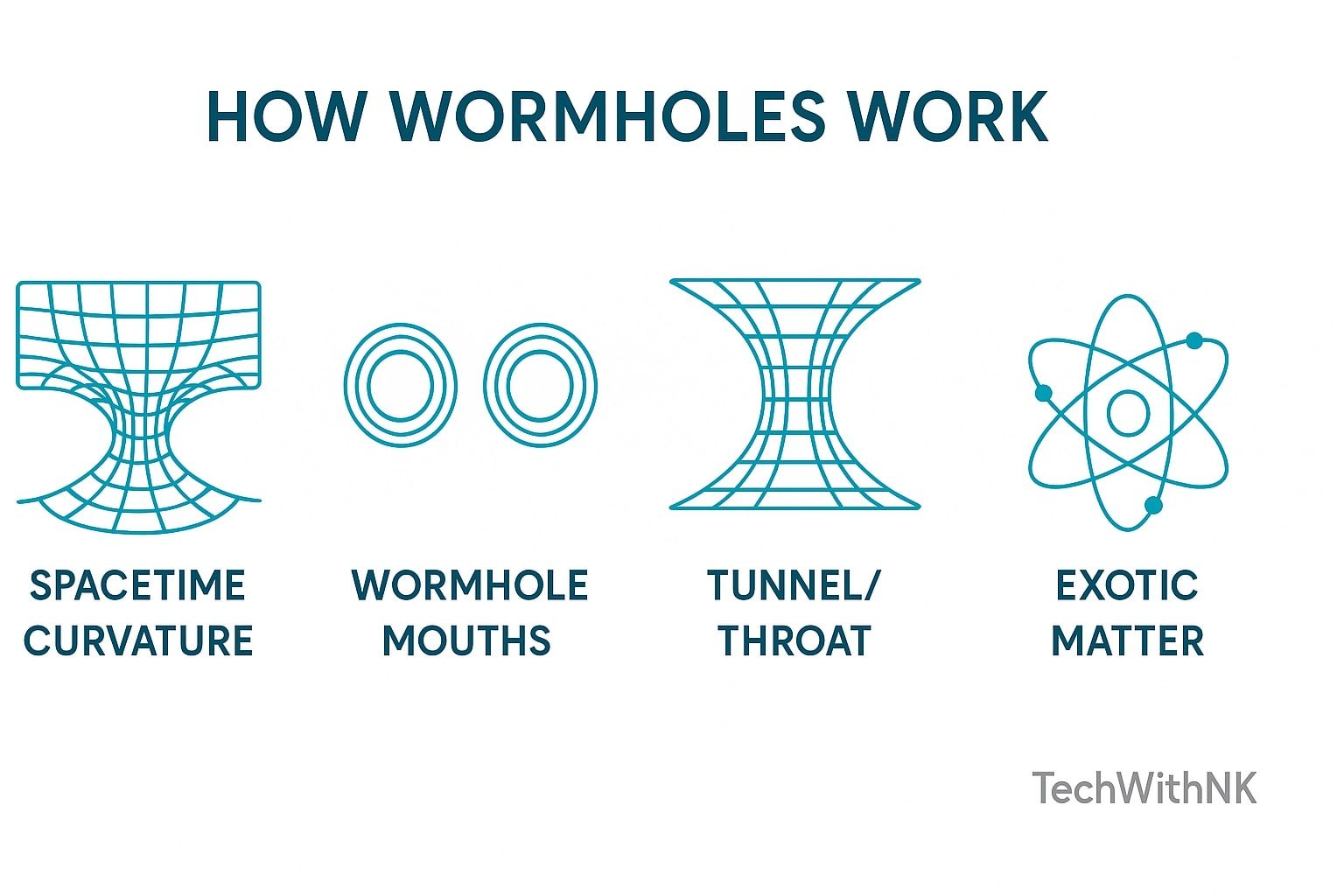
To understand how do wormholes work, imagine spacetime not as empty space but as a flexible sheet. This sheet can bend, twist, fold, or stretch. Under extreme conditions—such as near black holes—spacetime warps intensely.
A wormhole would require:
Two “mouths” (entrances)
A “throat” (tunnel connecting them)
Stability to stay open
The problem: gravity would instantly crush the tunnel. This is where exotic matter comes in.
Exotic Matter: The Key to Stable Wormholes
A wormhole can stay open only if there is something that generates negative energy or negative pressure. This theoretical substance is called exotic matter.
Exotic matter would:
Counteract gravity
Push the tunnel walls outward
Keep the wormhole open long enough to travel
We have never detected exotic matter in large amounts. However, small forms of negative energy (Casimir effect) have been observed in experiments — giving scientists hope.

Do Wormholes Exist in Space Right Now?
This is one of the biggest mysteries in astrophysics.
Why some scientists think they might exist:
The universe contains extreme gravitational environments (e.g., black holes).
Relativity allows the geometry for wormholes.
Dark energy and quantum fields might create conditions suitable for them.
Why others doubt it:
No observational evidence yet.
They require exotic matter, which we haven’t found in usable quantity.
Wormholes may collapse instantly, making them undetectable.
So the scientific answer to do wormholes exist is:
We don’t know yet — but nothing forbids them.
Wormholes vs Black Holes: Are They Related?
Wormholes are often confused with black holes, but they are completely different.
| Feature | Black Hole | Wormhole |
|---|---|---|
| What it is | A region with immense gravity | A tunnel in spacetime |
| Entry | One-way (you can’t escape) | Two-way (if stable) |
| Observed? | Yes | No evidence yet |
| Requires exotic matter? | No | Yes |
Some theories suggest that the center of a black hole might connect to another spacetime region — essentially a wormhole. But a traveler would be destroyed by gravity long before reaching it.
Quantum Wormholes: A Modern Twist
In recent years, physicists studying quantum mechanics discovered something interesting.
Two entangled particles may behave as if connected through a tiny wormhole. This idea is called:
ER = EPR (Einstein-Rosen = Einstein-Podolsky-Rosen)
This suggests that quantum entanglement and wormholes might be deeply connected. If true, wormholes in space may be microscopic and everywhere — but too tiny for travel.
Are Wormholes Possible for Time Travel?
Yes — mathematically.
If one wormhole mouth moves at relativistic speed (near the speed of light), time slows down for that mouth due to time dilation. When brought back, the two mouths are in different time frames (one older, one younger).
This means:
Enter one mouth → exit into the future
Enter the other mouth → exit into the past
This opens discussions on paradoxes like:
Grandfather paradox
Causality violations
Closed time-like curves
Most scientists believe that if wormholes exist, nature might prevent time-travel paradoxes from breaking physics.
Could Wormholes Be Hidden in Black Holes?
Some theories suggest that every black hole might hide a wormhole. This would mean black holes do not “destroy” information but transfer it elsewhere.
However:
No signal escapes the event horizon
We can’t see inside
We cannot test this theory yet
Still, simulations show that certain types of rotating black holes (Kerr black holes) might contain wormhole-like structures.
Will We Ever Discover a Real Wormhole?
Scientists are searching for signs:
Unusual gravitational lensing
Distorted starlight patterns
Strange radiation signatures
Anomalies in black hole behavior
If a wormhole mouth were large enough, we might detect it by how it bends light uniquely.
However, until we actually observe one, they remain theoretical.
Final Verdict: Are Wormholes Real?
Here’s the honest scientific conclusion:
Wormholes are mathematically possible.
Physics does not forbid them.
But we have zero observational proof so far.
Travel through them requires exotic matter we haven’t found.
So the answer to do wormholes exist or are wormholes possible is:
👉 They could be real — but we’re not sure yet.
They remain one of the universe’s most exciting mysteries.
As technology advances and our understanding of quantum physics improves, we might one day prove that wormholes are not just science fiction, but a real part of cosmic architecture. (NASA)